
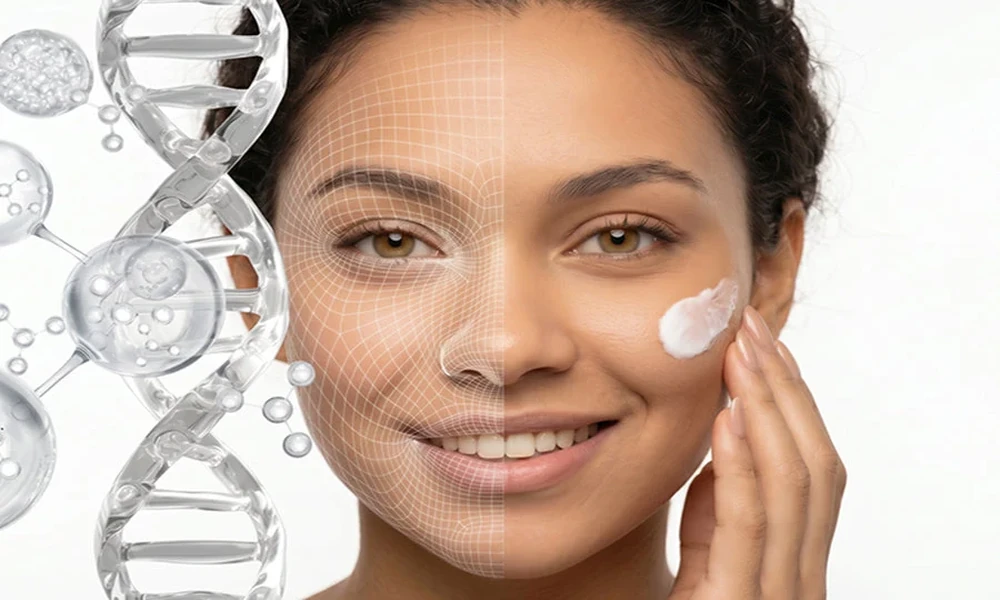

Can a cream do what a needle does? It is the question that sits behind a large and growing category of skincare, and the honest answer is more interesting than either the marketing or the skeptics suggest. Expression lines, the creases that form where facial muscles repeatedly fold the skin, have long been the territory of injectable neuromodulators. A parallel market of topical peptides now promises a gentler route to a similar goal. Comparing them fairly means separating mechanism from outcome, and evidence from hope.
Two different mechanisms aiming at one problem
Expression lines, think forehead furrows and the lines between the brows, are largely dynamic. They deepen when underlying muscles contract during frowning, squinting, and smiling, and over years those repeated folds etch into the skin. Any intervention has to address either the muscle movement, the skin quality, or both.
How injectables work
Injectable neuromodulators, the best known sold under the Botox name by Allergan, work by temporarily blocking the nerve signals that tell specific muscles to contract. Less contraction means the overlying skin folds less, and existing dynamic lines soften over the following days. The effect is well documented and typically lasts three to four months before muscle activity returns. It is a medical procedure, administered by a trained injector, and it acts on muscle rather than on the skin itself.
How topical peptides work
Peptides are short chains of amino acids that act as signalling molecules in the skin. Certain peptides are formulated to reduce the intensity of micro-contractions at the surface level, while others support the skin’s own production of structural proteins. A cream such as Crème Biofixine from Biologique Recherche illustrates the category: it pairs a muscle-relaxing peptide complex with botanical extracts and an oxygenating base, with the stated aim of relaxing expression lines caused by micro-contractions and restoring smoothness. The mechanism is topical and gradual, working on the skin rather than on the nerve-muscle junction a needle targets.
That distinction matters for managing expectations. A topical peptide is not a chemical equivalent of an injection delivered through a jar. It is a different tool with a different ceiling.
What the evidence supports, and where it thins out
Clinical data for injectable neuromodulators in treating dynamic expression lines is robust and longstanding. The results are predictable and visible, which is why the procedure became a dermatology mainstay.
Evidence for peptides is more nuanced. Laboratory and manufacturer studies indicate that specific peptides can influence the signalling involved in micro-contractions and can support the skin matrix over time. Independent, large-scale head-to-head trials against injectables are scarce, and honest formulators do not claim parity. What the better peptide products reliably deliver is improved hydration, smoother surface texture, and a modest softening of fine expression lines with consistent use over weeks and months. Readers evaluating any specific claim should check it against independent sources rather than a single product page.
The fair summary: injectables produce a larger, faster, temporary change in muscle-driven movement, while quality peptide creams produce a smaller, slower, cumulative improvement in skin quality and the appearance of fine lines.
Comparing the practical trade-offs
Invasiveness and commitment
Injectables require appointments, a qualified practitioner, and acceptance of a medical procedure with its own considerations. Topicals require only consistency. For people who are needle-averse or simply not ready for clinical intervention, that difference is decisive.
Onset and duration
Injectable results appear within days and fade over months, creating a maintenance cycle. Topical results build gradually and depend on continued use; stop applying and the benefit recedes. Neither is permanent. Both are, in effect, ongoing commitments of different kinds.
Cost structure
The costs are shaped differently rather than simply higher or lower. Injectables carry a recurring per-session fee several times a year. A premium peptide cream is a repeating product purchase. Over a year the totals can land closer together than people assume, though the experience and results differ.
Reversibility and control
A topical can be paused or stopped instantly with no lingering structural change. An injectable, once placed, runs its course until muscle activity naturally returns. Some people value the gentle, fully reversible nature of a cream precisely because it keeps them in control.
Who each option tends to suit
Neuromodulator injections tend to suit those seeking pronounced, reliable softening of established dynamic lines and who are comfortable with a clinical procedure and its maintenance schedule. They remain the stronger tool for significant, movement-driven creasing.
Topical peptides tend to suit those with early or fine expression lines, those who prefer a non-invasive daily routine, and those wanting to improve overall skin quality rather than isolate a single muscle group. They also serve as a complementary measure for people who do receive injectables and want to support the skin between sessions.
Framing the two as rivals can mislead. In practice many dermatologists and estheticians treat them as layers of the same strategy: a procedure that addresses movement, and a daily formula that maintains the skin. A patient might use both, or progress from topicals toward clinical options as concerns deepen.
Weighing the risk profiles
Considerations with injectables
As a medical procedure, neuromodulator injections carry considerations that a cream does not. Temporary bruising, swelling, or headache can occur, and results depend heavily on the skill of the injector. Asymmetry or an over-treated, frozen appearance is possible when placement or dosing is off, which is why practitioner credentials matter as much as the product itself. These effects are temporary, but the commitment to a qualified clinician is not optional. The procedure also requires medical screening, since it is not appropriate for everyone.
Considerations with topical peptides
Topicals carry a markedly lighter risk profile. Peptides are generally well tolerated across skin types, and adverse reactions are usually limited to irritation from other ingredients in a given formula rather than the peptides themselves. The main practical risk is disappointment: expecting an injection-level change from a cream and concluding that topicals do not work, when the honest expectation was always gradual, cumulative improvement. Patch testing any new formula remains sensible, particularly for reactive skin.
The role of the formulation
One caveat applies across the peptide category. Results depend not only on the type of peptide but on its concentration, its stability in the formula, and the supporting ingredients that help it penetrate. Two products naming the same peptide can perform very differently. This is a meaningful argument for sourcing from established professional lines and authorised retailers rather than choosing on marketing claims alone, since formulation quality is largely invisible on the label.
The measured conclusion
The cream-versus-needle debate rewards precision over slogans. Injectables win on speed and magnitude for dynamic lines. Peptide creams win on accessibility, reversibility, and broad skin-quality benefits, and they can meaningfully soften fine expression lines with patience. Anyone weighing the choice is best served by a consultation with a qualified professional who can assess the depth of the lines, the skin’s overall condition, and personal comfort with intervention. The right answer is rarely universal. It is the one matched to a specific face, a specific goal, and a specific tolerance for how results should arrive.
